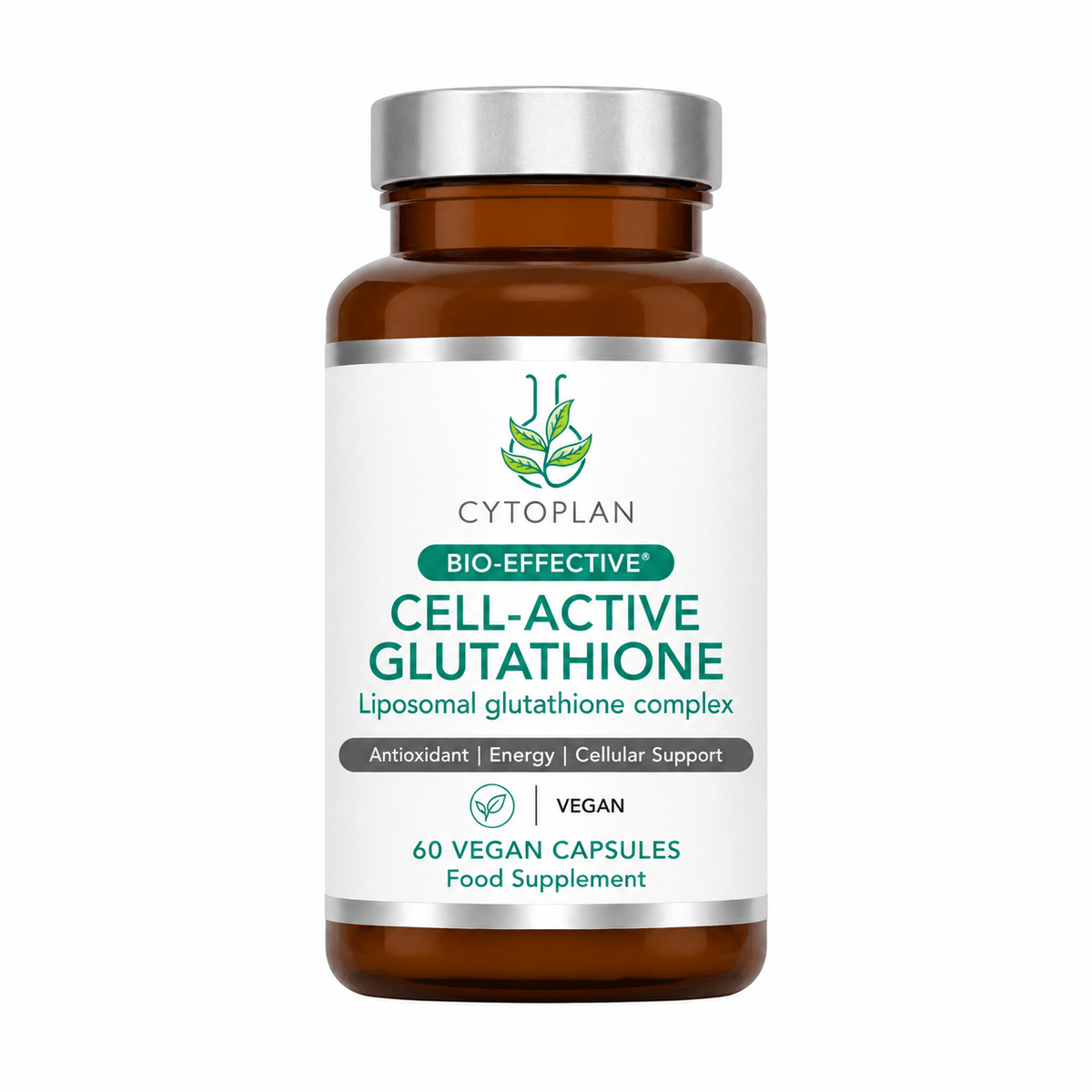
Cytoplan Cell-Active Glutathione – 60 Vegan Capsules
Cytoplan Cell-Active Glutathione – 60 Vegan Capsules
Couldn't load pickup availability
Ingredients, nutrition & safety
Ingredients, nutrition & safety
|
Serving Size: 1 Capsule
Servings Per Container: 60
|
| Nutrition Facts | Amount per serving |
| Liposomal Glutathione | 250 mg |
| N-Acetyl-L-Carnitine | 200 mg |
| Alpha Lipoic Acid | 100 mg |
| Ginkgo Biloba 50:1 Extract | 25 mg |
| Equivalent to Whole Ginkgo | 1,250 mg |
| Resveratrol | 25 mg |
| Rosemary Leaf 10:1 Extract | 12.5 mg |
| Equivalent to Whole Rosemary | 125 mg |
|
Ingredients:
Liposomal glutathione (phosphatidyl choline, palmitic acid, oleic acid), N-acetyl L-carnitine, alpha lipoic acid, resveratrol (from Japanese knotweed extract), ginkgo biloba extract, rosemary leaf extract, silicon dioxide, magnesium stearate, plant cellulose (capsule shell). |
|
Suggested Use: Take 1–2 capsules daily, 1–2 hours after food, or as directed by a practitioner. |
|
Warnings: People taking prescription medications should consult their doctor before taking this supplement. Not suitable for use during pregnancy or whilst breastfeeding. Storage: Store in a cool, dry place. Keep the capsules in their original container and close the lid tightly between uses. Do not transfer to daily tablet dispensers or other pill dispensers. |
Additional product information
Additional product information
Cytoplan Cell-Active Glutathione – Liposomal Glutathione & Multi-Nutrient Antioxidant Formula
Cytoplan Cell-Active Glutathione is a multi-ingredient supplement combining liposomal glutathione with N-acetyl-L-carnitine, alpha lipoic acid, resveratrol, ginkgo biloba and rosemary extract.
Each vegan capsule provides 250 mg of liposomal glutathione alongside five additional nutritional and botanical ingredients selected for their biochemical properties and relevance to antioxidant research.
Designed as a convenient multi-nutrient formulation, Cell-Active Glutathione brings together compounds involved in different aspects of cellular biology, oxidative processes and energy metabolism.
Understanding Glutathione – An Important Cellular Antioxidant
Glutathione is a naturally occurring compound found throughout the body. It is composed of three amino acids: glutamate, cysteine and glycine.
One of glutathione's most important physiological roles involves the body's antioxidant defence systems.
Within cells, glutathione participates in reactions that help regulate oxidative processes and maintain normal cellular function.
Glutathione is involved in:
- Cellular antioxidant reactions
- Maintaining the balance between reduced and oxidised glutathione
- Reactions catalysed by glutathione-dependent enzymes
- Normal cellular redox regulation
- Several physiological pathways involved in processing and eliminating certain compounds
Although glutathione is sometimes referred to as the body's "master antioxidant", this is an informal description rather than a recognised clinical classification.
The body synthesises its own glutathione, and its availability is influenced by nutritional status, metabolism and various physiological factors.
Liposomal Glutathione – Understanding the Delivery System
Glutathione supplements are available in several forms, including conventional reduced glutathione and lipid-based preparations.
Cytoplan Cell-Active Glutathione provides 250 mg of glutathione in a liposomal formulation.
Liposomes are lipid-based structures used in some nutritional and pharmaceutical delivery systems.
They are of scientific interest because the lipid environment can influence how certain compounds behave during digestion and absorption.
The liposomal ingredients in this product include:
- Phosphatidyl choline
- Palmitic acid
- Oleic acid
These components form part of the declared liposomal glutathione preparation.
Research into liposomal delivery is ongoing. However, the presence of a liposomal formulation does not by itself demonstrate superior absorption, delivery into specific tissues or improved clinical outcomes.
Such claims require evidence for the particular preparation and dose used.
Alpha Lipoic Acid – A Compound Involved in Cellular Metabolism
Alpha lipoic acid is a naturally occurring sulphur-containing compound involved in mitochondrial enzyme reactions.
It functions as a cofactor for certain enzyme complexes that participate in energy metabolism.
Alpha lipoic acid and its reduced form have also attracted scientific interest because of their chemical interactions with oxidative processes.
Each capsule of Cell-Active Glutathione provides 100 mg of alpha lipoic acid.
Research has investigated alpha lipoic acid in several contexts, including metabolic function, oxidative biomarkers and specific clinical conditions.
However, research findings depend on the dose, formulation and population studied and cannot automatically establish clinical benefits from this particular supplement.
N-Acetyl-L-Carnitine – A Nutrient of Interest in Energy Metabolism
Carnitine is a compound involved in the transport of long-chain fatty acids into mitochondria, where they can be used for energy production.
Acetyl-L-carnitine is an acetylated form of L-carnitine that has attracted research interest for its metabolic and neurological properties.
Cell-Active Glutathione provides 200 mg of N-acetyl-L-carnitine per capsule.
The compound has been investigated in relation to:
- Mitochondrial metabolism
- Fatty acid utilisation
- Neurological and metabolic processes
- Cellular energy pathways
These areas of research help explain the ingredient's inclusion in nutritional formulations, but they do not establish that taking this product increases energy levels or improves cognitive performance.
Resveratrol – A Plant Polyphenol
Resveratrol is a naturally occurring polyphenol found in certain plants, including grapes and Japanese knotweed.
It has been widely studied in laboratory research because of its interactions with cellular signalling pathways and oxidative processes.
Each capsule contains 25 mg of resveratrol derived from Japanese knotweed extract.
Resveratrol research has explored areas such as:
- Cellular signalling and metabolic pathways
- Oxidative stress biomarkers
- Inflammatory signalling mechanisms
- Age-related biological processes
Although laboratory findings have generated considerable interest, the clinical significance of resveratrol supplementation in healthy adults remains uncertain.
Results from high-dose clinical or laboratory studies cannot be directly applied to a supplement containing 25 mg per capsule.
Ginkgo Biloba & Rosemary – Two Researched Botanical Extracts
The formulation also contains concentrated extracts from ginkgo biloba and rosemary.
Ginkgo biloba is a tree species whose leaves contain a variety of naturally occurring plant compounds, including flavonoids and terpene lactones.
Each capsule provides 25 mg of a 50:1 ginkgo extract, equivalent to 1,250 mg of starting botanical material.
Ginkgo extracts have been investigated in research involving cognitive function, circulation and neurological processes. However, the composition of extracts varies, and evidence from particular standardised preparations cannot automatically be applied to other products.
Rosemary, scientifically known as Salvia rosmarinus, is an aromatic herb containing several naturally occurring polyphenols and related compounds.
Each capsule provides 12.5 mg of a 10:1 rosemary leaf extract, equivalent to 125 mg of starting plant material.
Rosemary has attracted scientific interest for constituents such as rosmarinic acid and carnosic acid, although the quantities of these individual compounds are not specified for this product.
Why Combine These Six Ingredients?
Cell-Active Glutathione brings together compounds with different biochemical characteristics in a single capsule.
The formulation contains:
- Liposomal glutathione: A naturally occurring tripeptide involved in cellular redox regulation.
- N-acetyl-L-carnitine: A carnitine derivative involved in metabolic research.
- Alpha lipoic acid: A compound with recognised roles in mitochondrial enzyme systems.
- Resveratrol: A plant polyphenol studied for its biological signalling properties.
- Ginkgo biloba: A traditional botanical ingredient containing flavonoids and terpene compounds.
- Rosemary extract: A concentrated herbal extract containing naturally occurring plant constituents.
The combination offers a convenient way to obtain these ingredients without purchasing six separate supplements.
However, the presence of multiple researched ingredients does not establish that they work synergistically or produce greater benefits when combined.
What Does the Scientific Research Say?
Glutathione and the other constituents in Cell-Active Glutathione have been studied across several areas of nutritional and biomedical research.
Research on oral glutathione has examined whether supplementation can influence glutathione concentrations and related biomarkers.
Some small human studies have reported changes in glutathione measures, but results vary according to preparation, dose and study design.
Alpha lipoic acid, acetyl-L-carnitine, resveratrol and botanical extracts have also been investigated for their individual biological properties.
When interpreting this research, several limitations are important:
- Research often involves individual ingredients rather than the complete formula.
- Different glutathione delivery systems may behave differently.
- Studies use varying doses, treatment durations and participant groups.
- Changes in laboratory biomarkers do not necessarily translate into noticeable health benefits.
- Clinical results cannot automatically be extrapolated to this specific combination.
Further product-specific research would be needed to establish the effectiveness of the complete formulation.
Who Might Consider Cell-Active Glutathione?
Cell-Active Glutathione may appeal to adults interested in the nutritional science of antioxidants and naturally occurring compounds involved in cellular metabolism.
It may be of particular interest to:
- Adults exploring glutathione-containing supplements
- People interested in liposomal ingredient delivery systems
- Individuals researching alpha lipoic acid and carnitine
- Those interested in polyphenols and botanical extracts
- Vegetarians and vegans seeking a multi-ingredient formulation
- People who prefer a combined supplement rather than several separate products
The product is not intended to diagnose, treat or prevent any medical condition. Individuals taking prescription medication should seek professional advice before use, particularly because the formula contains several biologically active compounds.
Vegan & Carefully Formulated
Cytoplan Cell-Active Glutathione uses plant cellulose capsules and is suitable for vegetarians and vegans.
Its formulation features:
- 250 mg liposomal glutathione per capsule
- 200 mg N-acetyl-L-carnitine
- 100 mg alpha lipoic acid
- 25 mg resveratrol from Japanese knotweed
- 25 mg ginkgo biloba 50:1 extract
- 12.5 mg rosemary leaf 10:1 extract
- Non-GM ingredients according to the manufacturer
- No added artificial flavourings or colourings
- 60 vegan capsules per container
The manufacturer also advises keeping the capsules in their original container rather than transferring them to a pill organiser.
Key Features at a Glance
- Multi-nutrient formula centred on liposomal glutathione
- 250 mg liposomal glutathione per capsule
- Includes alpha lipoic acid and N-acetyl-L-carnitine
- Contains resveratrol, ginkgo biloba and rosemary extract
- Clearly declared extract strengths and quantities
- Suitable for vegetarians and vegans
- 60 capsules providing a 30–60 day supply
Cytoplan Cell-Active Glutathione combines liposomal glutathione with a selection of nutritional and botanical ingredients in a convenient vegan capsule, offering a considered formulation for those interested in antioxidant research and cellular biochemistry.