Couldn't load pickup availability
Ingredients, nutrition & safety
Ingredients, nutrition & safety
|
Serving Size: 2 Capsules
Servings Per Container: 30
|
| Nutrition Facts | Amount per serving |
| Astaxanthin (NatAxtin®) | 8 mg |
| Vitamin E (as d-alpha tocopherol) | 3 mg α-TE (25% NRV) |
|
Ingredients:
Carrier (medium chain triglycerides), astaxanthin-rich oleoresin (as NatAxtin® from Haematococcus pluvialis algae), capsule shell (glycerol, modified pea starch, carrageenan), antioxidant (vitamin E as d-alpha tocopherol). |
|
Suggested Use: Take 2 capsules daily with food, or as directed by a practitioner. For children aged 10 years and above, the manufacturer recommends 1 capsule daily. Check suitability with a healthcare professional before giving this supplement to children. |
|
Warnings: Not suitable for use during planned pregnancy, pregnancy or breastfeeding. Do not take the full adult dose if under 14 years of age. If you are taking medication or have a medical condition, consult a doctor before use. Do not exceed the recommended daily intake. Food supplements should not be used as a substitute for a varied, balanced diet and healthy lifestyle. Keep out of sight and reach of children. Storage: Store in a cool, dry place away from direct sunlight and heat. Do not use if the sealing strip is missing or broken. |
Additional product information
Additional product information
Cytoplan Astaxanthin – High-Strength Algae-Derived Carotenoid with Vitamin E
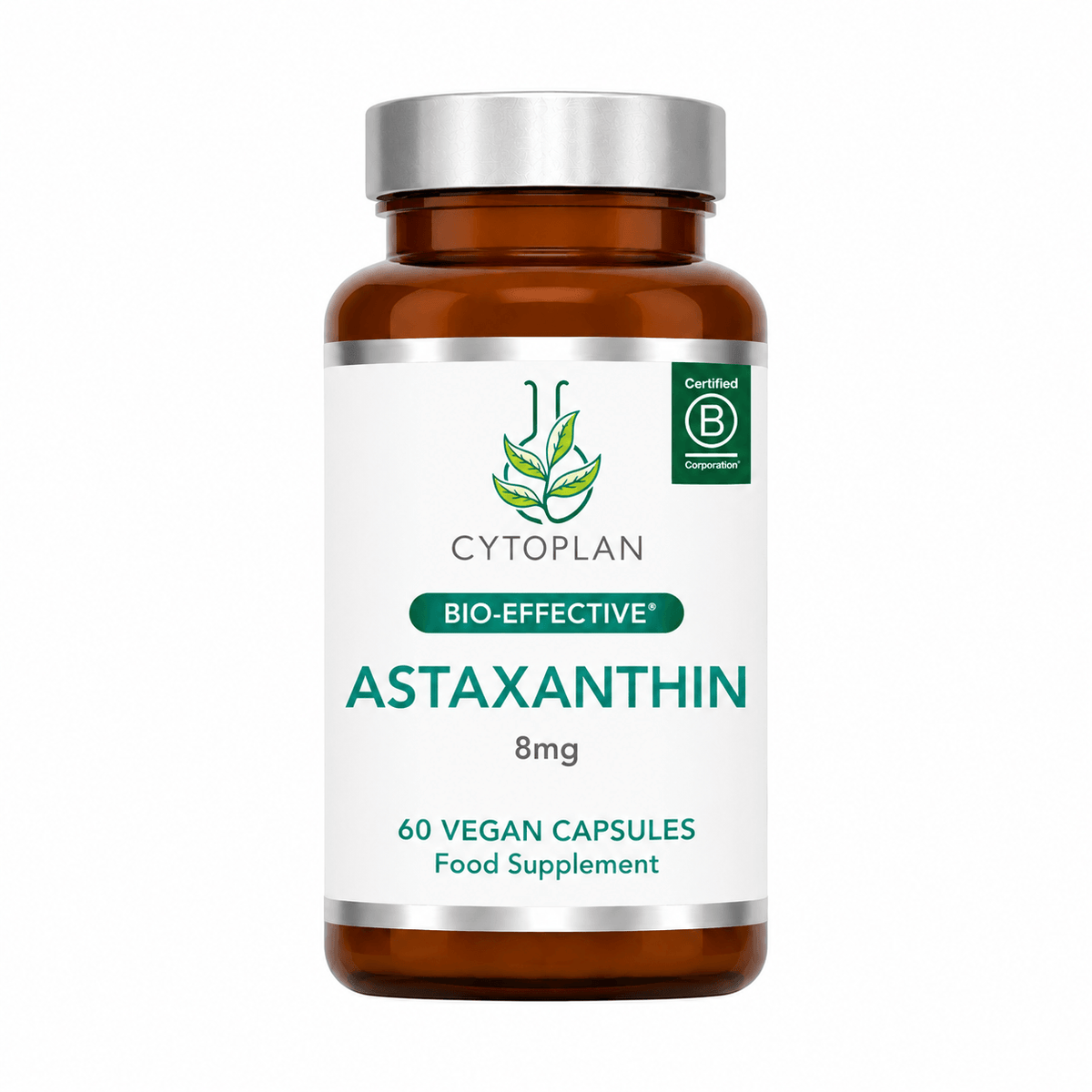
Cytoplan Astaxanthin is a concentrated, plant-based carotenoid supplement providing 8 mg of natural astaxanthin and 3 mg of vitamin E per daily serving of two vegan capsules.
The astaxanthin is supplied as NatAxtin®, derived from the freshwater microalga Haematococcus pluvialis, which is naturally rich in this distinctive red-orange pigment.
Astaxanthin has attracted scientific interest for its antioxidant properties and has been investigated in research involving skin, eye health and responses to physical exercise. The formulation also contains vitamin E, which contributes to the protection of cells from oxidative stress.
Astaxanthin – A Naturally Occurring Carotenoid
Astaxanthin belongs to the carotenoid family, a group of naturally occurring pigments responsible for many of the yellow, orange and red colours found in plants, algae and certain animals.
It is produced naturally by several microorganisms, including the freshwater microalga Haematococcus pluvialis.
In nature, astaxanthin is also responsible for the characteristic pink and red colouration of salmon, shrimp and other aquatic animals that obtain it through their food.
Researchers have investigated astaxanthin because of its molecular structure and its interactions with biological membranes and oxidative processes.
Research has explored:
- Astaxanthin's antioxidant properties
- Its behaviour within lipid-containing biological membranes
- Skin responses to environmental exposure
- Visual function and eye-related biomarkers
- Oxidative processes associated with physical exercise
These areas of investigation explain the growing scientific interest in astaxanthin. However, the findings do not establish that all astaxanthin supplements produce measurable health benefits.
NatAxtin® – Natural Astaxanthin from Microalgae
Cytoplan uses NatAxtin®, an algae-derived astaxanthin ingredient produced from Haematococcus pluvialis.
According to Cytoplan, the algae are cultivated in Chile's Atacama Desert, where natural sunlight and carefully managed growing conditions support astaxanthin production.
The manufacturer highlights several characteristics of its sourcing process:
- Algae-derived: Astaxanthin is obtained directly from microalgae rather than fish or shellfish.
- Natural cultivation: Production uses natural sunlight as an important part of the algae-growing process.
- Traceable ingredient: NatAxtin® is identified by name, allowing customers to distinguish the ingredient source.
- Vegan formulation: The ingredient is suitable for people who avoid animal-derived supplements.
- Concentrated serving: Each two-capsule serving provides 8 mg of astaxanthin.
Astaxanthin content can vary between algal preparations, making the declared amount of the active carotenoid an important consideration when comparing products.
Understanding Antioxidants & Oxidative Stress
Oxidative processes are a normal part of human physiology. Cells continuously produce reactive molecules through metabolic activity and interactions with the environment.
The body has several systems that regulate these processes, including antioxidant enzymes and protective compounds obtained through the diet.
Oxidative stress occurs when the balance between reactive molecules and protective systems becomes disrupted.
Astaxanthin has been extensively investigated in laboratory experiments because of its ability to interact with certain reactive molecules.
Its molecular structure allows it to associate with lipid-rich environments, including biological membranes.
However, laboratory measurements of antioxidant activity do not necessarily predict the effects of supplementation in humans.
There is currently no established UK-authorised health claim that astaxanthin supplementation itself protects human cells from oxidative stress.
Vitamin E – Contributing to Cellular Protection
Alongside natural astaxanthin, Cytoplan includes vitamin E as d-alpha tocopherol.
Vitamin E is an essential fat-soluble nutrient that contributes to the protection of cells from oxidative stress.
Each daily serving provides 3 mg vitamin E, equivalent to 25% of the adult Nutrient Reference Value.
Vitamin E is particularly important within lipid-containing structures, where it participates in the body's normal antioxidant protection systems.
The combination provides:
- 8 mg natural astaxanthin from microalgae
- 3 mg vitamin E as d-alpha tocopherol
- A convenient oil-based capsule preparation
- Two fat-soluble compounds in one vegan supplement
While vitamin E has an established nutritional role, combining it with astaxanthin does not automatically demonstrate an enhanced or synergistic clinical effect.
Astaxanthin & Skin Health Research
Skin is exposed to numerous environmental influences, including sunlight, air pollution and changes in temperature and humidity.
Astaxanthin has been investigated in human studies examining skin hydration, elasticity, texture and responses to environmental exposure.
Some small clinical trials have reported improvements in selected skin-related measurements following astaxanthin supplementation.
However, results differ between studies, and several limitations should be considered:
- Research has used different astaxanthin doses and preparations.
- Some studies have involved relatively small participant groups.
- Outcomes vary according to age, skin characteristics and study duration.
- Changes in skin measurements do not necessarily translate into visible benefits for everyone.
The available research is of scientific interest but does not establish that Cytoplan Astaxanthin prevents skin ageing, protects against UV damage or replaces appropriate sun protection.
Astaxanthin & Eye Health Research
The eyes are metabolically active tissues that rely on normal physiological processes to maintain visual function.
Carotenoids have attracted considerable attention in nutritional research because several members of this family occur naturally in ocular tissues or participate in biological processes relevant to vision.
Astaxanthin has been investigated in studies exploring visual fatigue, accommodation and certain aspects of eye function.
Some clinical research has reported changes in selected visual measurements, but findings remain insufficient to establish consistent benefits across different populations.
It is also important to distinguish astaxanthin from lutein and zeaxanthin, which are different carotenoids with distinct roles in the macular pigment of the eye.
Astaxanthin supplementation should not be considered a replacement for appropriate eye care, routine examinations or treatment of diagnosed eye conditions.
Exercise, Recovery & Astaxanthin Research
Physical activity produces a range of normal physiological responses, including changes in energy metabolism, muscle activity and oxidative signalling.
Astaxanthin has attracted research interest because some of these processes involve reactive oxygen species and antioxidant pathways.
Human studies have investigated whether astaxanthin supplementation influences:
- Exercise-related oxidative biomarkers
- Muscle recovery measurements
- Selected endurance and performance outcomes
- Markers associated with physiological responses to exercise
The results have been mixed. Some studies report changes in particular outcomes, while others find little or no meaningful improvement.
These findings do not establish that astaxanthin enhances athletic performance, prevents muscle damage or accelerates recovery in people taking this product.
Training, recovery time, adequate nutrition and sleep remain central considerations for physical performance.
Why Choose an Algae-Derived Astaxanthin Supplement?
Astaxanthin can be obtained from different sources, including microalgae and marine organisms.
For people following vegetarian or vegan diets, obtaining astaxanthin directly from algae avoids the need for animal-derived ingredients.
Cytoplan's formulation offers:
- Natural astaxanthin sourced from Haematococcus pluvialis
- Clearly identified NatAxtin® ingredient
- 8 mg astaxanthin per recommended daily serving
- Additional vitamin E
- Vegan-friendly capsule materials
- Convenient daily dosing with food
Because astaxanthin is fat-soluble, taking the supplement with food is consistent with the manufacturer's recommended directions.
What Does the Scientific Research Say?
Astaxanthin is widely studied in laboratory, animal and human research.
Its antioxidant properties have been characterised in experimental systems, while human trials have examined its potential influence on skin-related measurements, visual function and exercise-associated outcomes.
When interpreting these studies, it is important to consider several factors:
- Results from laboratory experiments cannot automatically be translated into human health benefits.
- Clinical studies have used different doses, including amounts both below and above 8 mg daily.
- The type and source of astaxanthin may differ between formulations.
- Some studies are small or limited in duration.
- Changes in biomarkers do not always correspond to meaningful clinical improvements.
- Evidence from individual ingredients does not establish the effectiveness of every finished product.
The current evidence makes astaxanthin an interesting subject for nutritional research, while highlighting the importance of avoiding exaggerated claims about its benefits.
Who Might Consider Cytoplan Astaxanthin?
Cytoplan Astaxanthin may appeal to adults interested in carotenoid nutrition, algae-derived supplements and the developing research surrounding antioxidant compounds.
It may be of particular interest to:
- Adults researching natural carotenoids
- People interested in the nutritional science of skin and eye health
- Physically active individuals exploring antioxidant research
- Vegetarians and vegans seeking an algae-derived formula
- Those interested in a supplement combining astaxanthin with vitamin E
- Individuals who prefer a clearly declared astaxanthin quantity
Supplement suitability depends on individual circumstances, including diet, age, health status and medication use.
Astaxanthin is not a substitute for a balanced diet, adequate sun protection or appropriate medical care.
Clean, Vegan & Straightforward Formulation
Cytoplan Astaxanthin provides a concentrated algae-derived carotenoid in a vegan capsule containing medium chain triglycerides and vitamin E.
- Suitable for vegetarians and vegans
- Contains NatAxtin® natural astaxanthin
- Derived from Haematococcus pluvialis microalgae
- Provides 8 mg astaxanthin per daily serving
- Contains 3 mg vitamin E
- No fish or shellfish ingredients
- Non-GM formulation according to the manufacturer
- Free from wheat, soy and dairy
- No added sugar, flavourings or colourings
- 60 vegan capsules providing 30 daily servings
Key Features at a Glance
- 8 mg natural astaxanthin per two-capsule serving
- NatAxtin® sourced from microalgae
- Includes vitamin E, which contributes to the protection of cells from oxidative stress
- Carotenoid ingredient investigated in skin, eye and exercise-related research
- Algae-derived alternative to animal sources of astaxanthin
- Suitable for vegetarians and vegans
- 60 capsules providing a 30-day supply
Cytoplan Astaxanthin combines 8 mg of algae-derived NatAxtin® astaxanthin with vitamin E in a convenient vegan formulation, offering a considered supplement choice for those interested in carotenoid nutrition and the developing science of antioxidant compounds.